
Flow Motion Policy: Manipulator Motion Planning
with Flow Matching Models

Davood Soleymanzadeh1 Xiao Liang2,† Minghui Zheng1,†
1Department of Mechanical Engineering 2Department of Civil and Environmental Engineering
Texas A&M University
† Corresponding Author
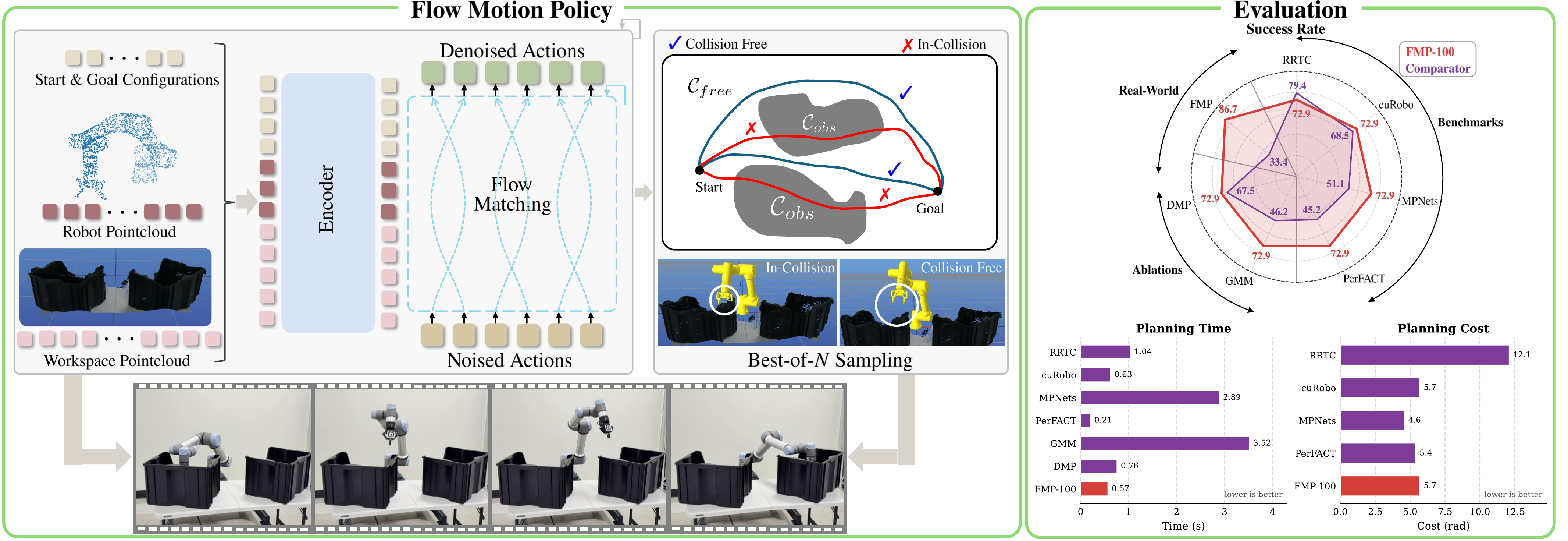
Flow Motion Policy overview: point cloud conditioned flow policy with best-of-N sampling

Method Overview. Flow Motion Policy is a point cloud–conditioned flow-based motion policy that enables best-of-N sampling for motion planning in complex environments. The framework leverages the generative formulation of flow matching to capture the inherent distribution of motion planning datasets and supports efficient inference-time best-of-N sampling. Compared to neural informed samplers (MPNets) and end-to-end deterministic planners (PerFACT), Flow Motion Policy achieves higher planning efficiency.

Abstract

Open-loop end-to-end neural motion planners have recently been proposed to improve motion planning for robotic manipulators. These methods enable planning directly from sensor observations without relying on a privileged collision checker during motion planning. However, existing planners produce a single path for a given planning problem and cannot exploit their open-loop nature to propose multiple motion plans. To address this limitation, we introduce Flow Motion Policy, an open-loop neural motion planner that uses flow matching to generate a batch of motion plan proposals by learning a distribution over motion plans conditioned on the planning observation. At inference time, it samples multiple candidate motion plans to enable efficient best-of-N inference while avoiding iterative collision checking during planning. We benchmark Flow Motion Policy against representative sampling-based, optimization-based and neural motion planning methods. Evaluation results demonstrate that Flow Motion Policy improves planning success and efficiency, highlighting the effectiveness of stochastic generative policies for end-to-end motion planning and best-of-N sampling.

Highlights

Learn many motion proposals first, validate them once.

Flow Motion Policy amortizes planning into a stochastic trajectory generator: it proposes complete joint-space paths from point-cloud observations, then uses batched validation to select a feasible one.

0.16s

single-sample planning time for FMP-1, the fastest setting in our benchmark.

Best-of-N

sample many candidate paths at inference without retraining the policy.

Point clouds

condition on robot and workspace geometry directly from scene observations.

86.7%

real-world success with FMP-100 across 30 physical manipulation tasks.

Method

Method

Flow matching turns planning into conditional trajectory sampling.

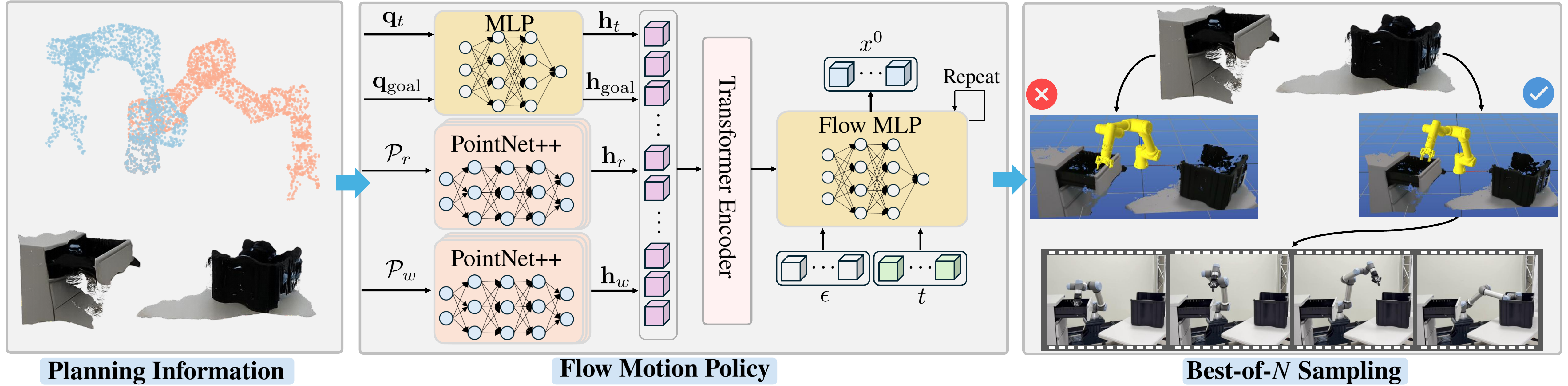
Given the current configuration, goal configuration, robot point cloud, and workspace point cloud, FMP learns a distribution over joint-space action chunks rather than predicting a single path.

pθ(δqt:t+H−1 | qt, qgoal, P)
1

Encode Planning Context

Embed current/goal configurations and robot/workspace point clouds into shared planning tokens.

2

Generate Candidate Paths

Use a flow head to transform Gaussian noise into autoregressive joint-space action chunks.

3

Select a Feasible Plan

Validate sampled trajectories in batch and choose a collision-free candidate for execution.

Flow Motion Policy architecture: encoder + flow MLP + best-of-N sampling

Flow Motion Policy Architecture. A transformer encoder fuses configuration and point-cloud tokens, then conditions a flow MLP that denoises Gaussian samples into joint-space action chunks for best-of-N planning.

Training Setup

We use an LLM-based workspace generator to create motion planning environments and cuRobo to generate expert trajectories. The training dataset contains approximately 3.5 million trajectories from ~500 generated workspaces. The same dataset and training setup is used for Flow Motion Policy, all neural baselines, and all ablation models to ensure fair comparison. All experiments run on an NVIDIA RTX 4080 GPU.
Results

We compare Flow Motion Policy against nine baselines across six manipulation environments: sampling-based — RRT-Connect (RRTC), BIT*; optimization-based — cuRobo, cuRobo-Vox; neural informed samplers — MPNets, SIMPNet, GAIDE; and end-to-end neural planners — PerFACT. FMP-1 uses a single candidate (N=1); FMP-100 uses best-of-100. Five metrics are reported: planning time T [s], success rate SR [%], path length C [rad], smoothness S, and jerk J.

Comparison with Benchmark Planners

Ablations & Comparisons

We compare Flow Motion Policy against an adapted Neural MP baseline that uses a Gaussian Mixture Model (GMM) head for inference-time best-of-N sampling. Flow Motion Policy consistently outperforms the GMM-based policy across all tasks. This is due to its flow matching formulation, which captures more complex path distributions than a fixed-component GMM, and to its substantially lighter architecture — enabling faster inference and more diverse candidate generation.

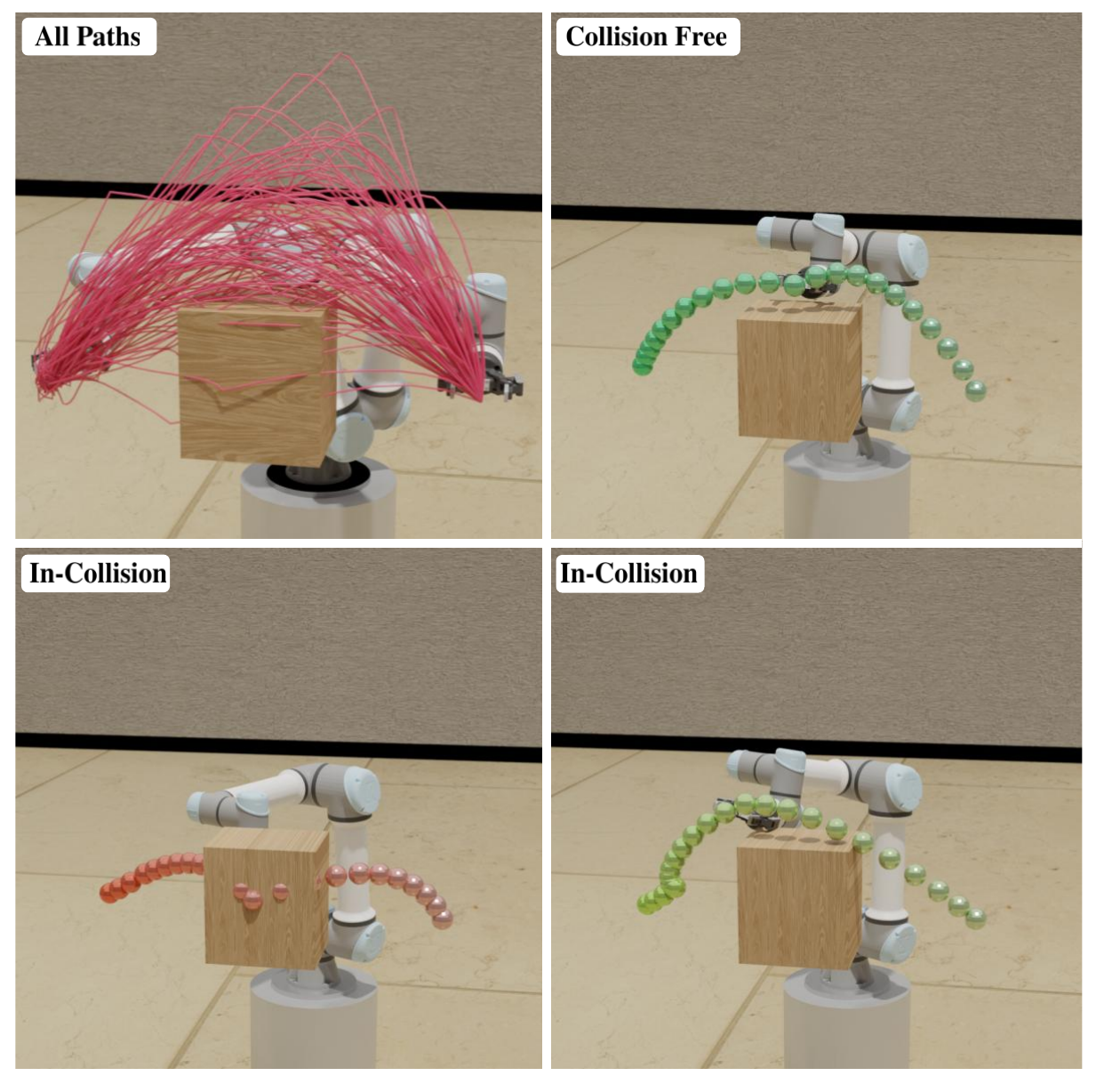
For a fixed start-goal-scene query, Flow Motion Policy generates diverse trajectory proposals — not copies of a single dominant path. Diversity is measured as the average pairwise joint-space trajectory distance across sampled candidates. The spread is meaningful and consistent: it persists even within the collision-free subset, indicating the model has learned a genuine distribution over feasible motions rather than collapsing to a single mode.

Fixed-Query Diversity (N = 100)

Samples per query Collision-free Pairwise diversity (all) Pairwise diversity (collision-free) FMP-1 success FMP-100 success
300 300 / 300 0.26 rad 0.26 rad 43.5% 62.3%

All 300 sampled trajectories reach the goal and are collision-free for this query, with consistent pairwise diversity across the full and feasible subsets.

Path diversity: all paths vs collision-free paths

For a fixed query, FMP samples diverse paths (left: all candidates; right: collision-free subset). The spread across the workspace confirms proposal diversity rather than mode collapse.

Increasing the number of sampled trajectories improves success rate across all policy heads, with diminishing returns at larger N. The MLP head offers the strongest time-to-solution trade-off, reaching 75% success at N = 200 in only 0.48 seconds, while the larger U-Net, Transformer, and DiT heads require more inference time.

We ablate the policy head design by testing four flow architectures (MLP, U-Net, Transformer, DiT) and comparing each against a diffusion-based counterpart (DMP) with the same encoder backbone. FMP consistently outperforms DMP across architectures and N values, reaching higher success with fewer inference function evaluations. The MLP head delivers the best speed-accuracy trade-off; heavier architectures add marginal accuracy at the cost of higher latency. Use the tabs below to compare N=1 vs N=100, and success rate vs. planning time.

We study how the number of function evaluations (NFE) — denoising steps for DMP, Euler integration steps for FMP — affects the success-time trade-off. FMP is robust to a reduced step count: cutting NFE significantly from the default lowers planning time with minimal impact on success rate. DMP degrades more noticeably under the same reduction, reflecting a fundamental difference in how the two generative formulations distribute their computation across steps.

Increasing N monotonically improves success rate for both FMP and DMP across all head architectures. FMP scales more efficiently — reaching comparable or higher success than DMP at the same N, while generating candidates faster. Toggle between FMP and DMP, and between Success Rate and Planning Time, to compare the full picture. Hover over the chart to read exact values at each N.

We sweep the number of Euler solver steps (5–90) across all head architectures, with and without best-of-N selection. Success rate barely changes with step count — the flow policy already produces high-quality samples with very few steps. Planning time, however, grows linearly. Toggle between N=1 / N=100 and Success Rate / Planning Time. Hover for exact values.

Real-World Deployment

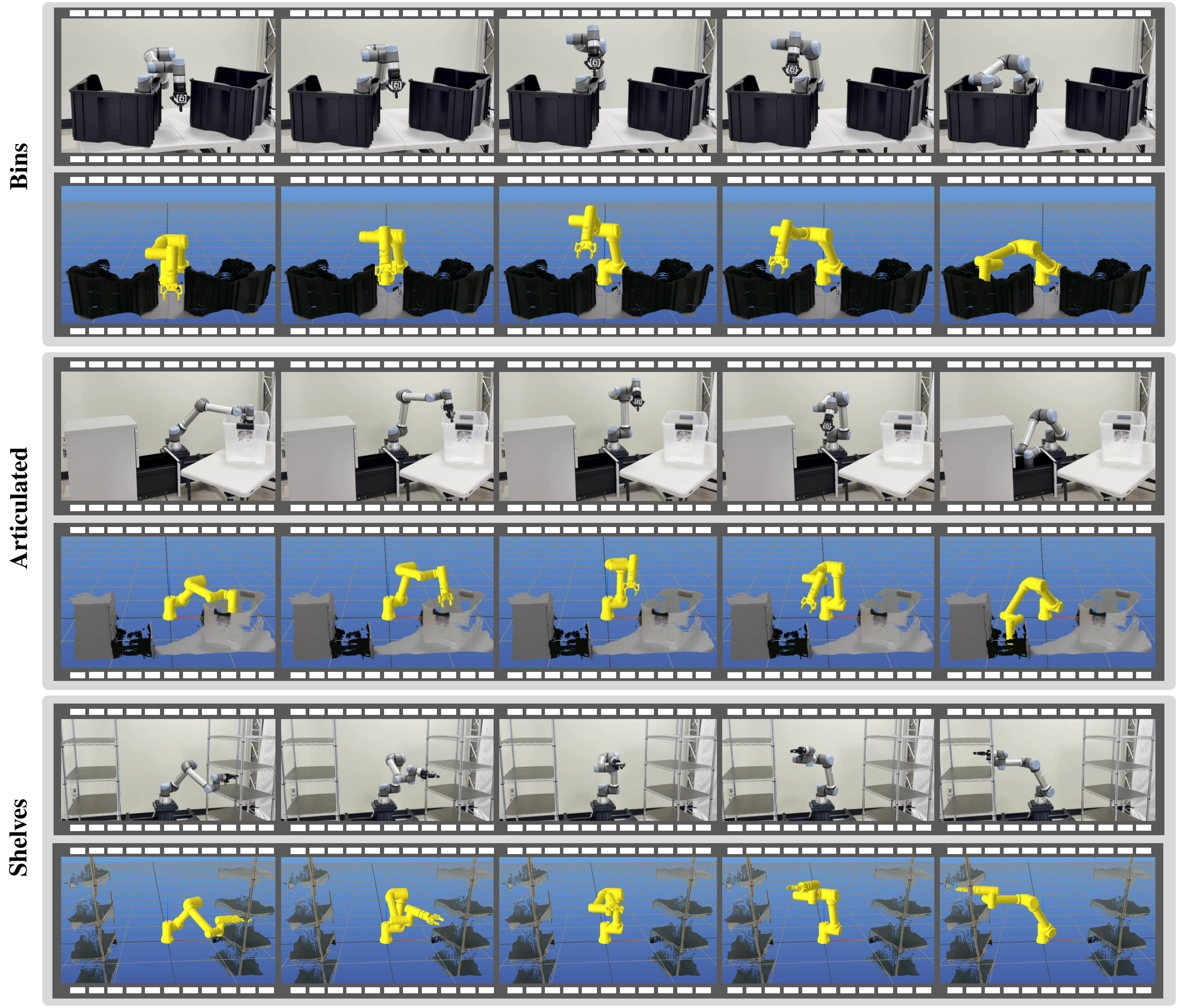
We deploy Flow Motion Policy on a UR5e robotic manipulator in real-world environments without any additional training or fine-tuning. A calibrated Intel RealSense D435i RGB-D camera captures the workspace point cloud. AprilTag markers estimate the camera-to-robot transform. Three task types are evaluated: Bins, Articulated, and Shelves.

Real-world success rate. FMP-100 solves all Bins and Articulated tasks and improves total success from 33.4% to 86.7%.

Real-world deployment: Bins, Articulated, and Shelves tasks

Real-World Deployment. FMP-100 plans collision-free paths across three real-world task categories: 1. Bins, 2. Articulated, and 3. Shelves, without any retraining.

BibTeX

@article{soleymanzadeh2026flowmotionpolicy,
  title   = {Flow Motion Policy: Manipulator Motion Planning with Flow Matching Models},
  author  = {Soleymanzadeh, Davood and Liang, Xiao and Zheng, Minghui},
  journal = {arXiv preprint arXiv:2604.07084},
  year    = {2026}
}