Challenges and Opportunities
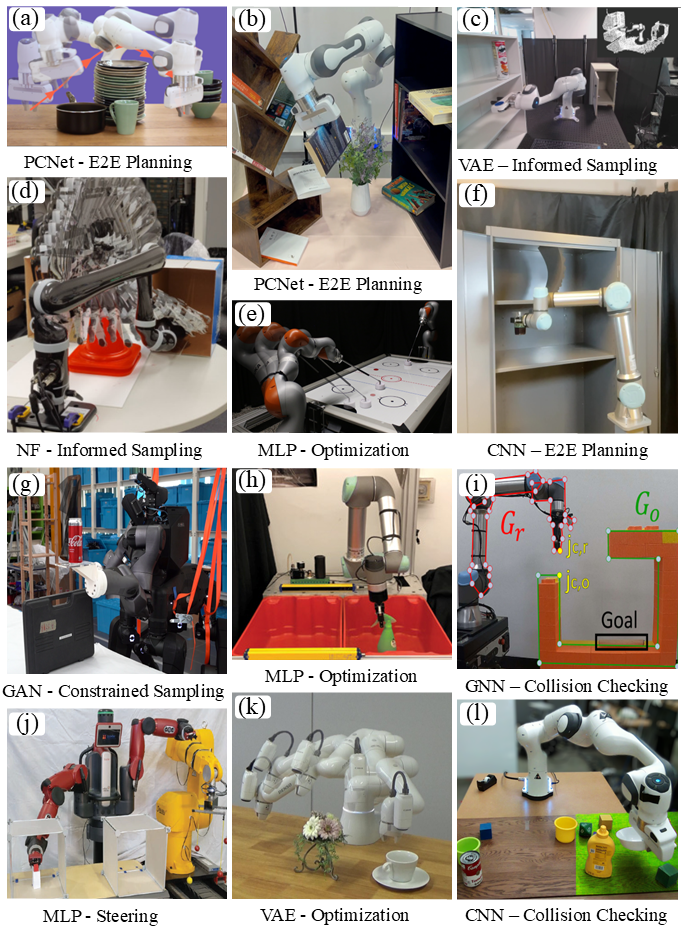
The survey organizes neural motion planners by where learning enters the planning stack: end-to-end planning, sampling, steering, trajectory optimization, and collision checking.
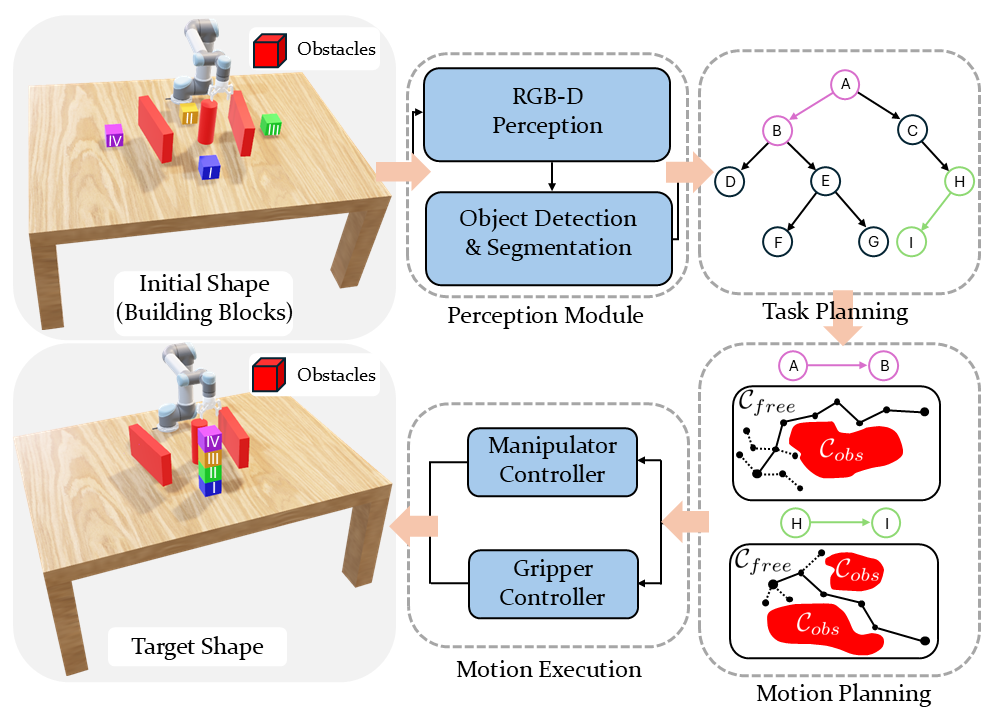
State-of-the-art generalist manipulation policies have enabled robotic manipulators to operate in unstructured human environments. However, these frameworks still struggle in cluttered settings because they often rely on auxiliary modules for low-level motion planning and control. Motion planning remains difficult due to high-dimensional configuration spaces and workspace obstacles. Neural motion planners improve planning efficiency through fast inference and by modeling the multimodality of planning problems, but they often struggle to generalize to unseen, out-of-distribution settings. This survey reviews neural motion planners for robotic manipulators, analyzes their benefits and limitations, and outlines a path toward generalist neural motion planners.
Read it as an atlas: choose the planning component you care about, see what neural methods have been used, and understand the remaining gap to robust deployment.
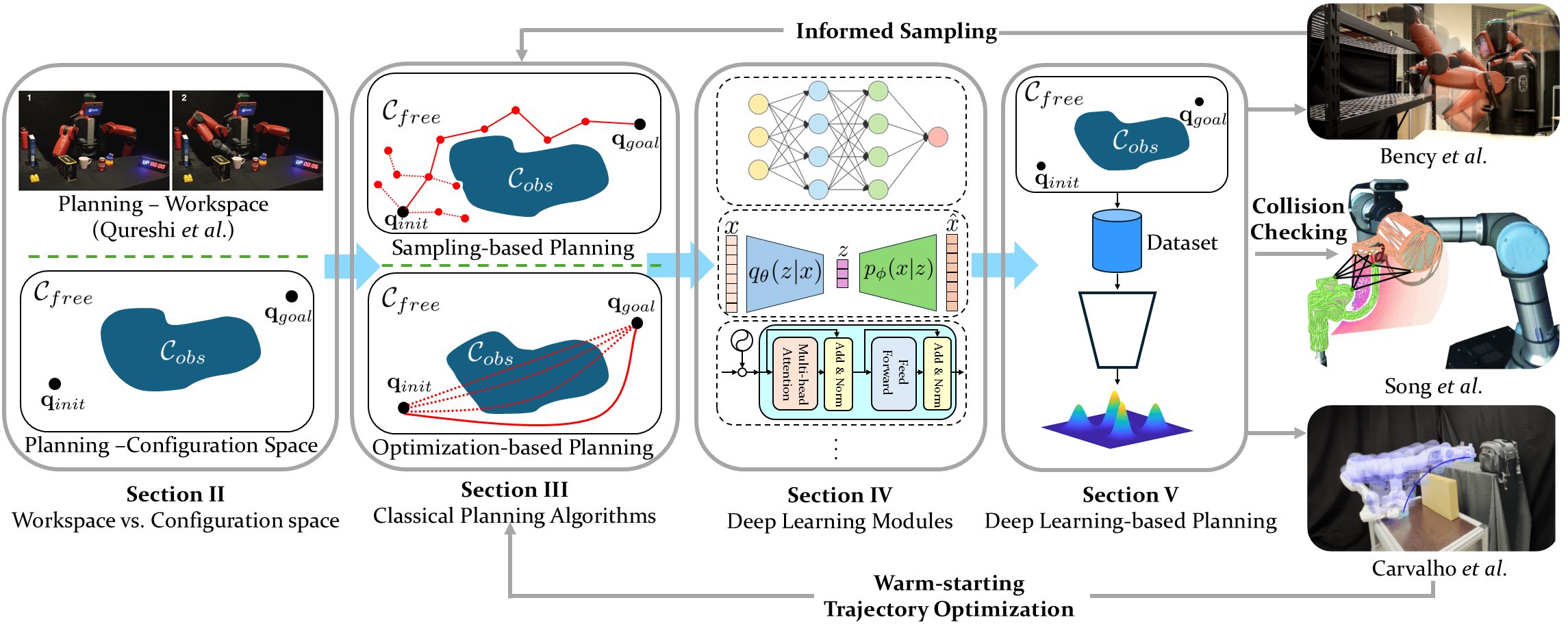
Connects workspace, configuration space, sampling, steering, optimization, and collision checking.
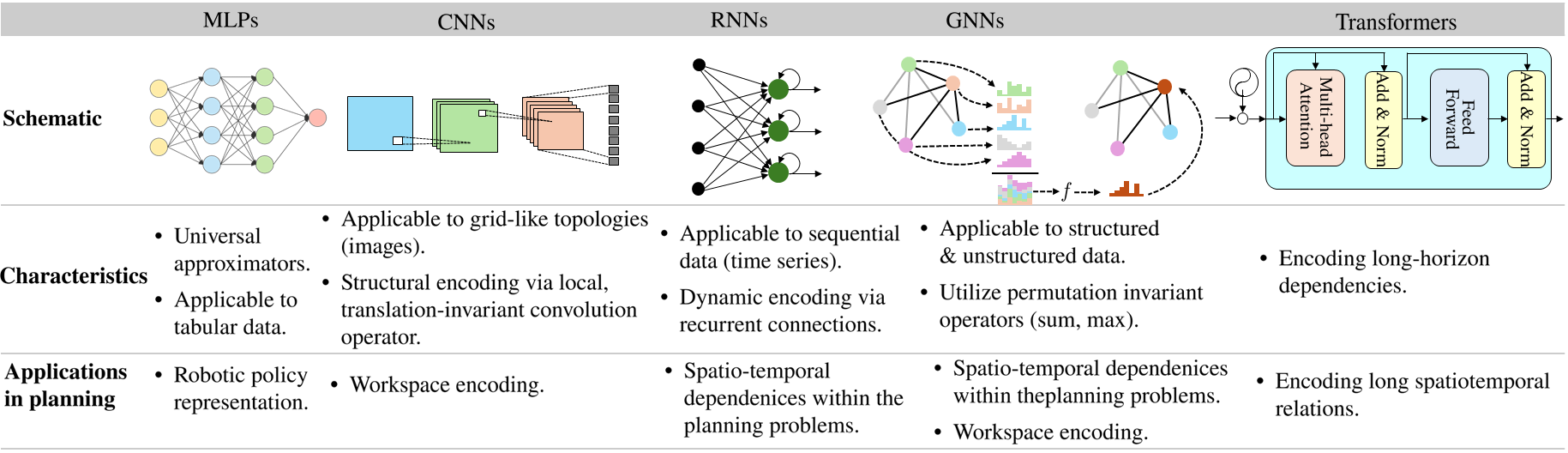
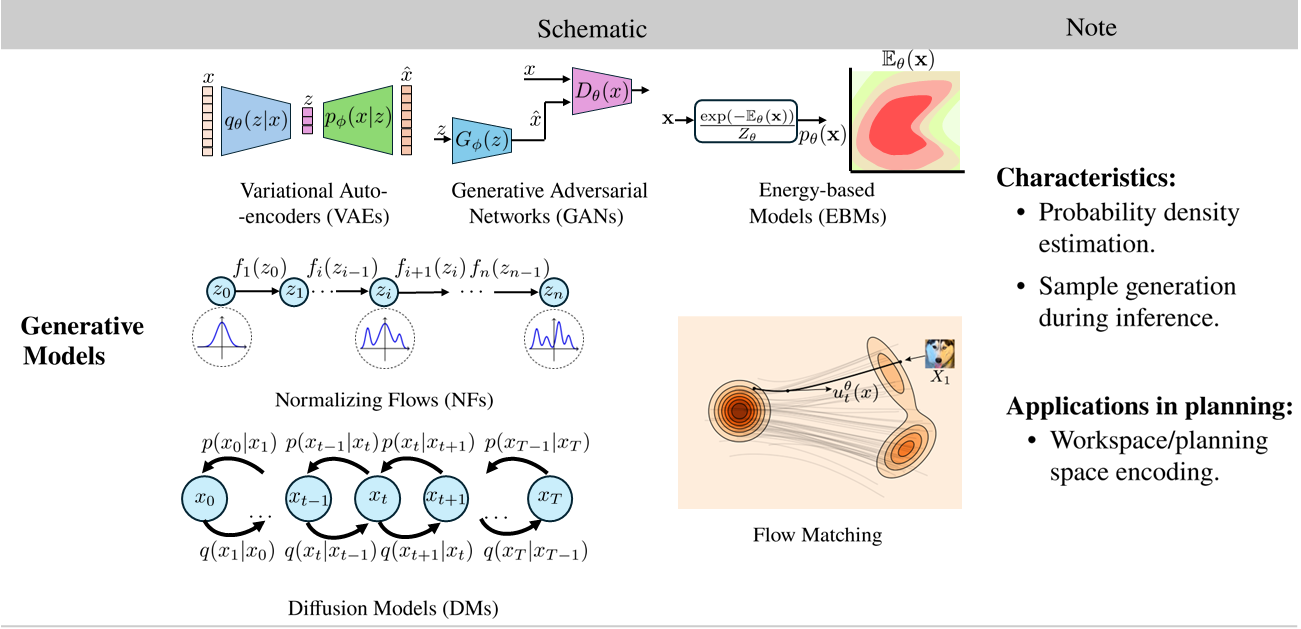
Summarizes MLPs, CNNs, transformers, GNNs, generative models, point clouds, and neural fields.
Groups reviewed work by where learning improves the planning pipeline.
Highlights generalization, safety, data, benchmarking, and domain-specific deployment challenges.
The paper starts from motion planning preliminaries, then moves through classical planners, deep learning modules, neural planning methods, challenges, and application domains.
Toggle between the major layers of the survey. Each tab shows the role of the component, the relevant neural methods, and the figure that best supports that part of the paper.
Neural planners differ less by name and more by what they represent: configuration samples, full trajectories, collision proxies, distance fields, or scene-conditioned policies.
An expandable tree of the reviewed papers, organized using the taxonomy from Section V of the survey. Search by title, model family, year, or planning role.
Move from narrow training distributions to unseen robots, objects, obstacles, and task contexts.
Combine fast neural inference with verifiable constraints, collision guarantees, and runtime monitors.
Scale trajectory data while reducing dependence on expensive expert planners and brittle simulators.
Benchmark success, planning time, cost, smoothness, safety, and out-of-distribution robustness consistently.
Bridge high-level generalist policies with low-level motion generation and physical feasibility.
Adapt neural planners to healthcare, re-manufacturing, and other settings where risk and constraints matter.
Manipulation autonomy stack
Core neural modules
Generative model families
@article{soleymanzadeh2026towards,
author = {Soleymanzadeh, Davood and Lopez-Sanchez, Ivan and Su, Hao and Li, Yunzhu and Liang, Xiao and Zheng, Minghui},
title = {Towards Generalist Neural Motion Planners for Robotic Manipulators: Challenges and Opportunities},
journal = {IEEE Transactions on Automation Science and Engineering},
year = {2026}
}