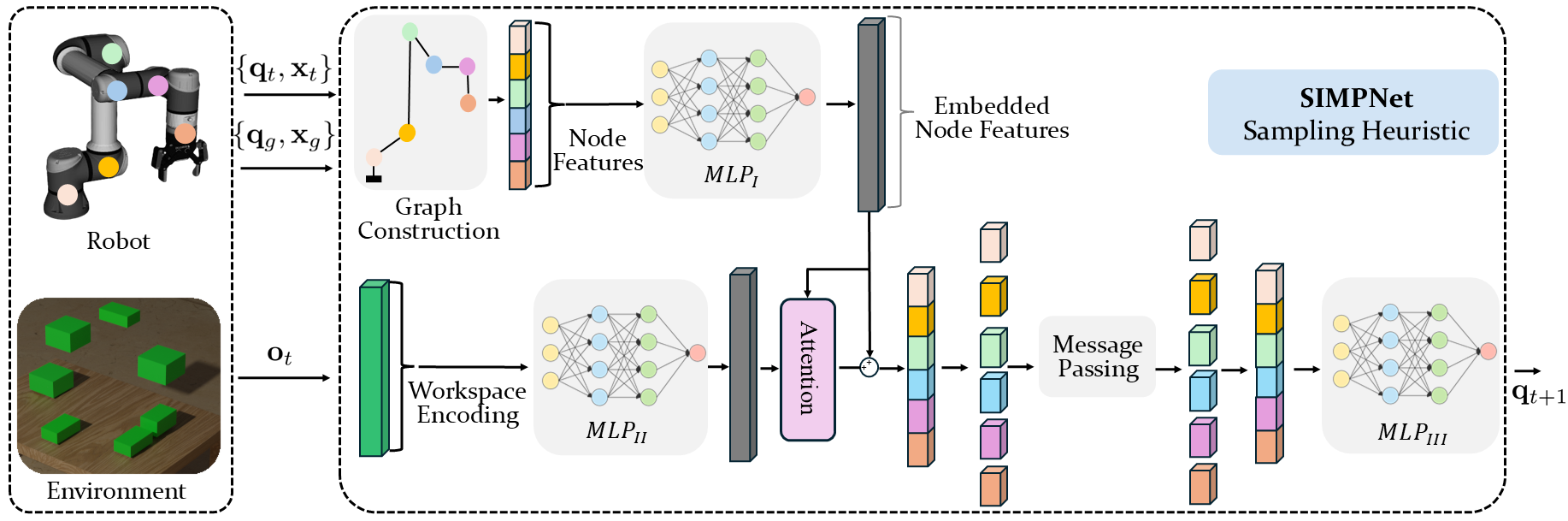
Method Overview. SIMPNet is a neural informed sampler for sampling-based motion planning. It represents the manipulator kinematic chain as a graph, embeds workspace observations, and uses cross-attention to generate spatially informed configuration-space samples for bidirectional planning.
Robotic manipulators require fast and efficient motion planners to operate in cluttered environments. Sampling-based planners can struggle in high-dimensional configuration spaces because uniform or hand-crafted sampling heuristics often require many collision checks. SIMPNet addresses this limitation with a stochastic graph neural network sampling heuristic. The method encodes the manipulator's kinematic structure as a graph and uses cross-attention to condition configuration-space sampling on workspace embeddings. Experiments with a UR5e manipulator in simple and complex workspaces show that SIMPNet improves planning efficiency and remains competitive with sampling-based and neural planning baselines.
SIMPNet keeps the sampling-based planner structure, but replaces uninformed sampling with a learned stochastic heuristic that is aware of robot kinematics and workspace geometry.
Encodes the UR5e kinematic chain as a graph for spatially informed sample generation.
Injects workspace embeddings into configuration-space sampling.
planning time in the unseen simple environment benchmark.
success rate in the unseen simple environment benchmark.
SIMPNet learns a stochastic sampling heuristic that proposes the next configuration using the current state, goal state, robot graph features, and workspace embedding.
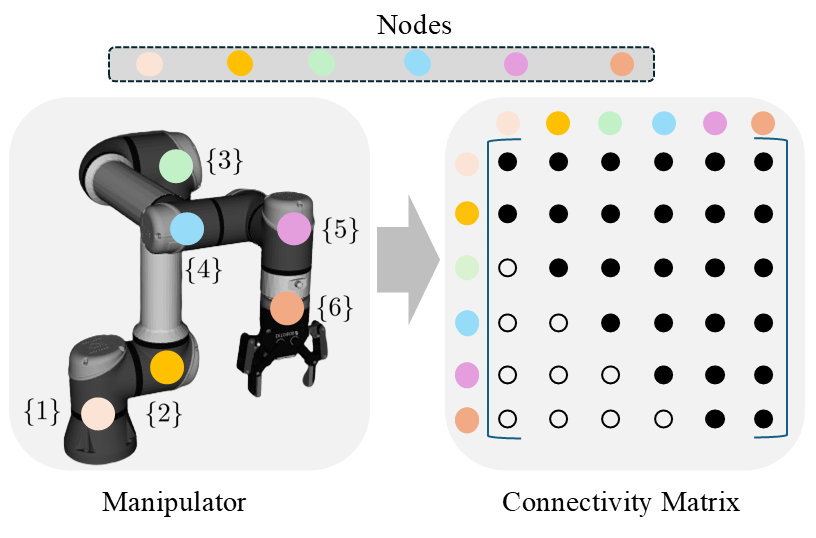
Represent joints and links as graph nodes and edges that follow the manipulator kinematic chain.
Use cross-attention to condition graph features on the workspace embedding.
Generate stochastic samples inside a bidirectional sampling-based planner.
Graph Construction. The manipulator's kinematic structure is encoded as a graph, allowing message passing over robot joints.
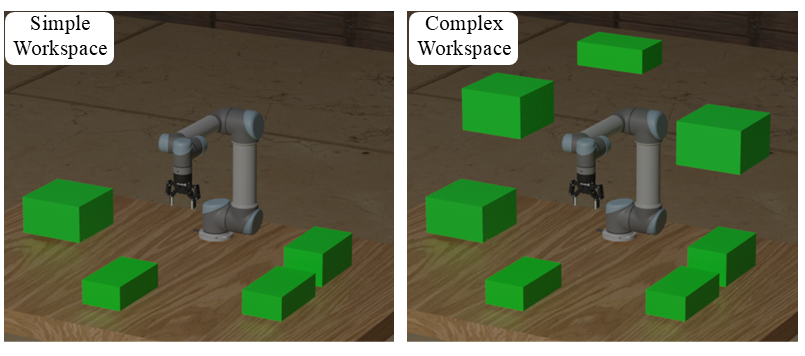
Evaluation Environments. SIMPNet is trained and evaluated in simple and complex workspaces.
We compare SIMPNet with classical sampling-based planners and neural informed samplers across seen and unseen simple and complex environments. The interactive chart reports planning time, planning cost, and success rate from the published RA-L paper. Figure 6 from the paper is not reproduced here as a separate image; its comparison is represented through the recoverable table values below.
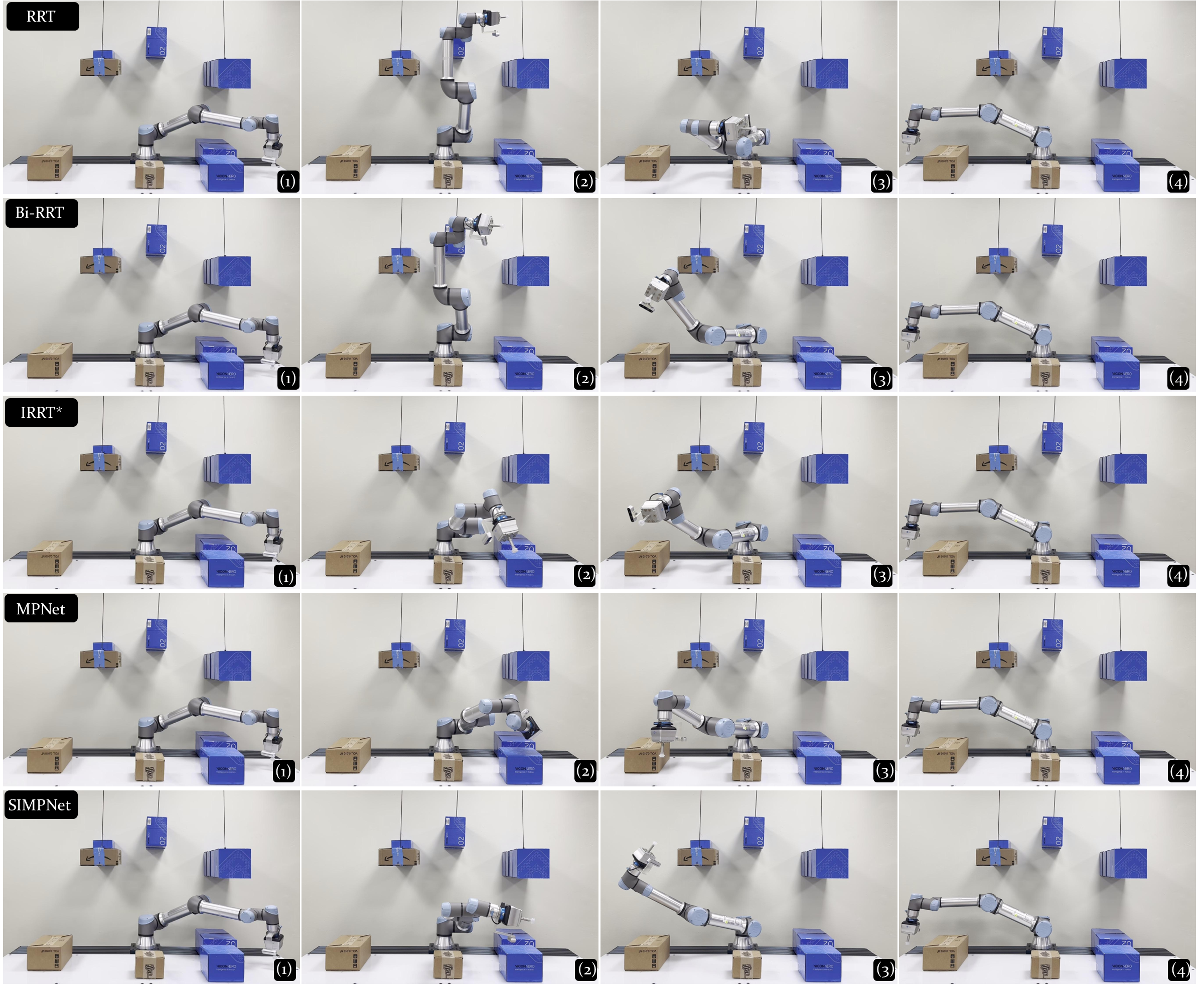
Planning Example. Qualitative comparison of SIMPNet with benchmark planners in a complex workspace.
We summarize two ablations from the paper: removing forward-kinematics information from the graph features and evaluating SIMPNet under different obstacle counts.
Bi-RRT (x8)
IRRT* (x4)
MPNet (x4)
SIMPNet (x4)
@article{soleymanzadeh2025simpnet,
title = {SIMPNet: Spatial-Informed Motion Planning Network},
author = {Soleymanzadeh, Davood and Liang, Xiao and Zheng, Minghui},
journal = {IEEE Robotics and Automation Letters},
year = {2025},
publisher = {IEEE}
}